A City of Diamonds: Ahmadabad in the Mughal Era
Ahmadabad, located in the western Indian state of Gujarat, was once a thriving hub for trade, particularly renowned for its skilled diamond cutters and gemstone merchants. In the 17th century, this city played a vital role in the flourishing gem trade of the Mughal Empire. It was here, along the banks of the Sabarmati River, that a now-legendary diamond was purchased by one of history’s most celebrated gem traders.
Jean-Baptiste Tavernier: The Merchant and the Memoirist
Between 1630 and 1668, the French explorer and jeweler Jean-Baptiste Tavernier undertook six extensive voyages across the East, including India, Persia, and Southeast Asia. His detailed account, Travels in India, offers rare insights into the gem trade of his time. Among the many treasures he encountered, Tavernier described a remarkable diamond he acquired in Ahmadabad. This diamond, initially weighing 178 ratis (approximately 157.5 modern carats), was cut down to 94.5 carats to remove flaws and improve its shape.
This diamond was so significant that Tavernier included illustrations of both its rough and cut forms, an uncommon practice for his writings, marking the occasion as the only recorded instance of him doing so for a single gem.
Who Was the “Friend”? Unraveling a Mystery
Tavernier mentioned that he bought the diamond for a “friend,” a vague term that has puzzled historians and gemologists for centuries. Some speculate that this friend was King Louis XIV of France, known for acquiring many exceptional diamonds from Tavernier. Others suggest that the gem might have ended up in the court of Aurangzeb, the last of the powerful Mughal emperors and a well-known patron of rare diamonds.
However, there is no official record of this gem entering the French Crown Jewels, nor does it appear in any catalog of Iranian royal gems. It remains unclear whether the diamond was meant for European royalty or an influential courtier within the Mughal Empire.
The Diamond Resurfaces: Christie’s, Geneva, 1995
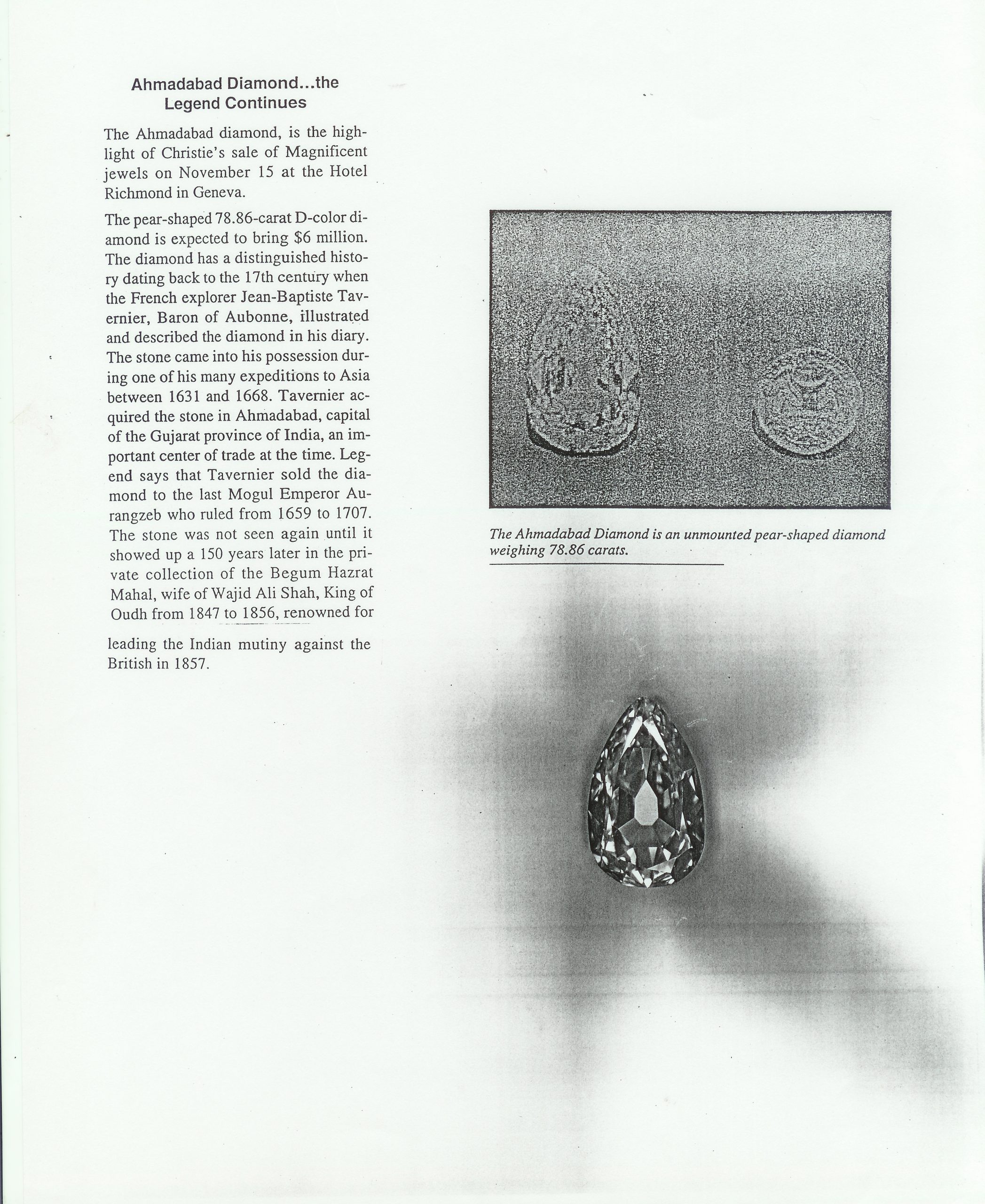
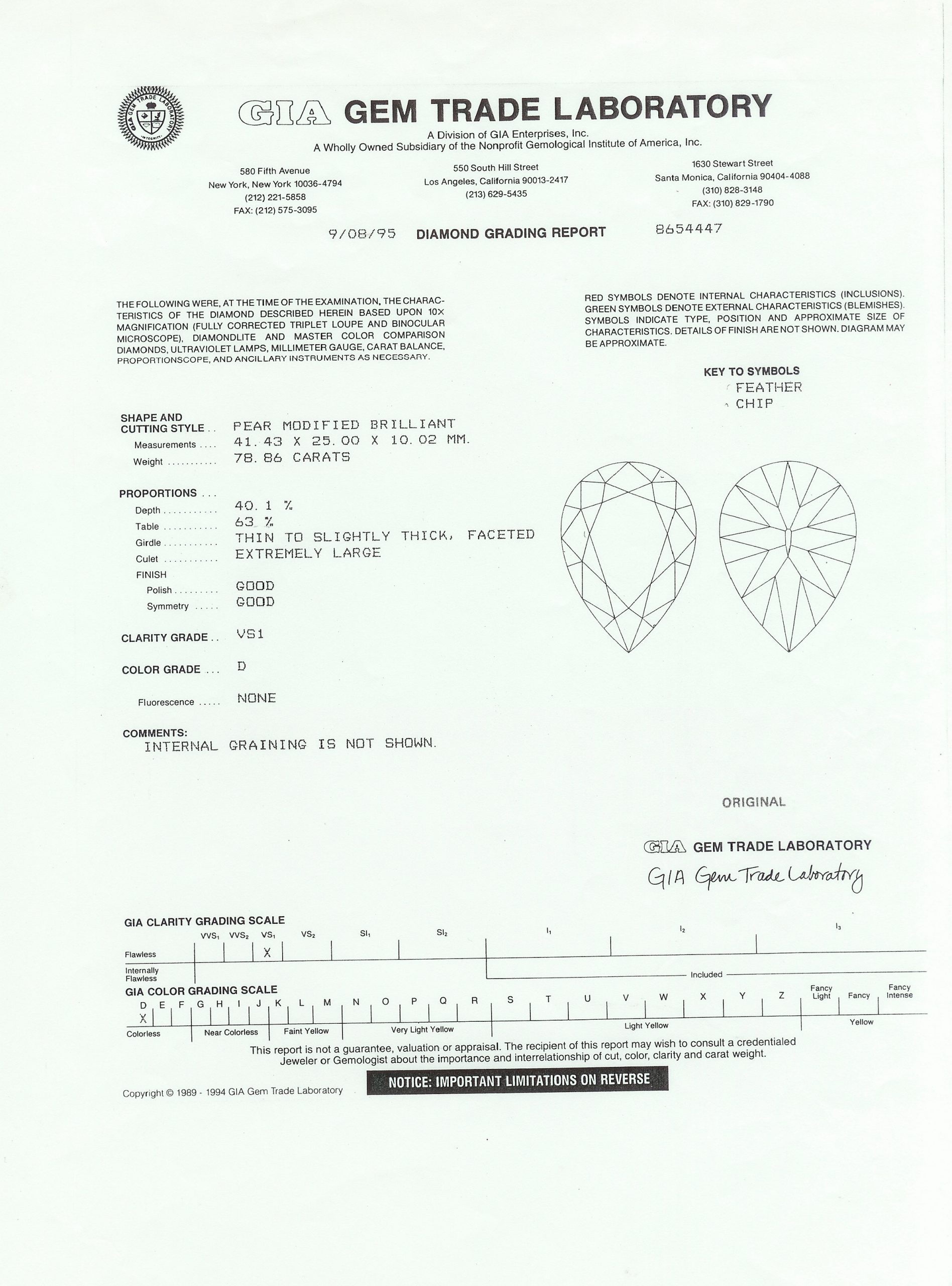
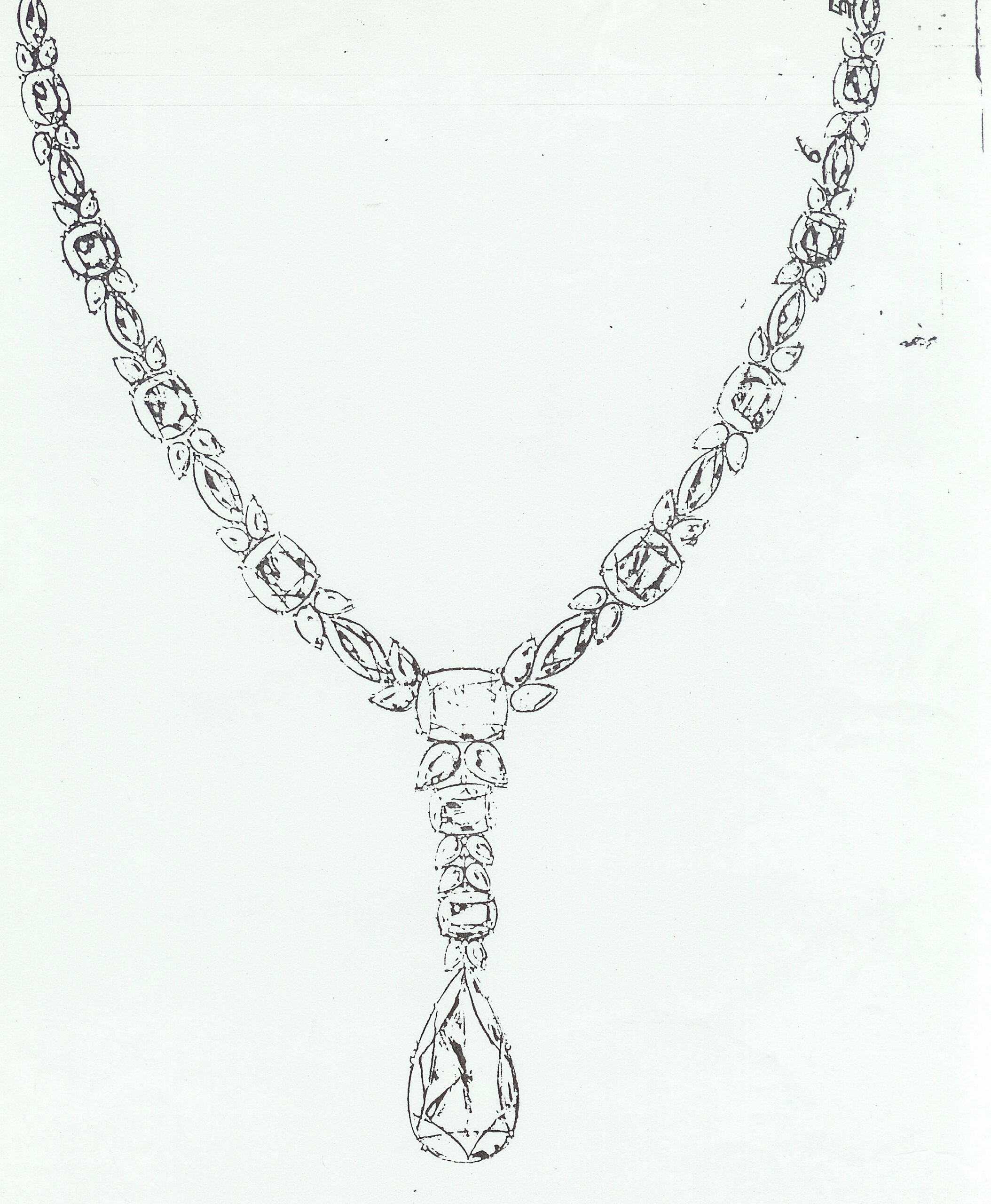
The trail of the Ahmadabad Diamond reemerged in modern history during a Christie’s auction in Geneva in November 1995, where a striking pear-shaped diamond weighing 78.86 carats was presented for sale. Graded by the Gemological Institute of America (GIA) as D-color and VS1 clarity, the stone exhibited exceptional purity and brilliance, with a notably large culet and a cutting style suggestive of antique craftsmanship.
The diamond was purchased by Robert Mouawad, a renowned gem collector, for $4.3 million USD.
Gemological Grading
Weight: 78.86 carats
Color: D (colorless)
Clarity: VS1, with improvement potential
Cut: Antique pear-shaped brilliant
Provenance: Unconfirmed
Sale History: Christie’s Geneva, 1995. Acquired by Robert Mouawad
The diamond’s current form features horizontally split pavilion mains, a distinctive feature of older cutting techniques. The unusually large culet and slightly flattened shape have led some to suggest it was once a double-sided rose cut or briolette that was later reshaped.
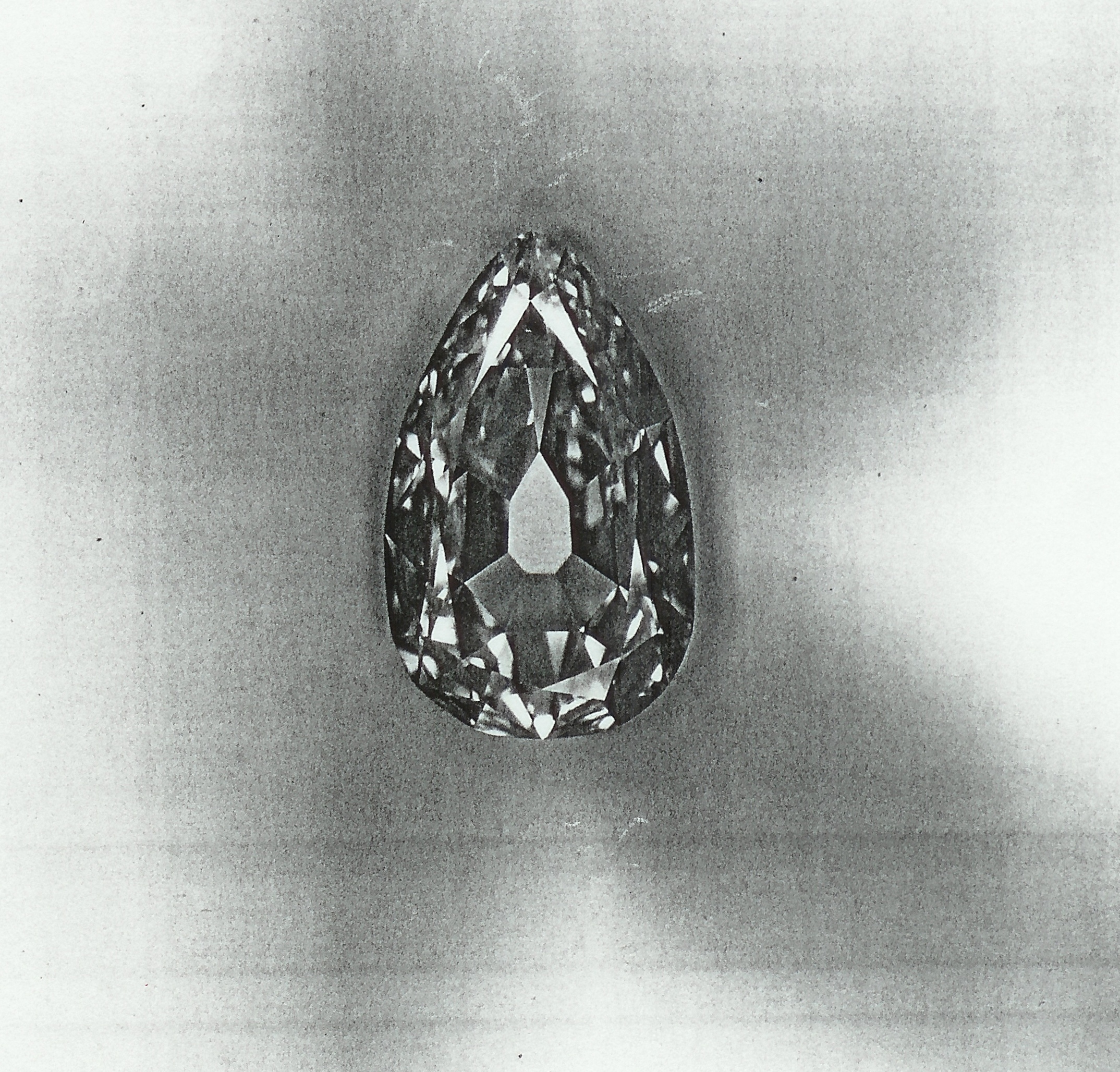
These are photos of the Ahmadabad Diamond which I actually handled: (More info below which mentions that it was purchased by Robert Mouawad. These happened when I was with Mouawad in Jeddah, Saudi Arabia in 1995.
Ahmadabad, the capitol of the Indian state of Gujarat, is located 550 km north of Bombay, on the Sabarmati River. The city has long been a center for trading and cutting diamonds, both of which are still pursued there today (although to a lesser degree). One famous visitor to Ahmadabad in the 1600s was the French traveller and gem merchant, Jean Baptiste Tavernier. Over a period of 40 years, he made six trips to the East. In chapter XXII of part II of his book Travels in India, Tavernier described some of the notable diamonds and rubies which he had seen during the course of his travels, often accompanied with illustrations, from which the following is from:
“No. 4 represents a diamond which I bought at Ahmadabad for one of my friends. It weighed 178 ratis, or 157½ of our carats…[no. 5] represents the shape of the above mentioned diamond after it had been cut on both sides. Its weight was then 94½ carats. The flat side, where there are two flaws at the base, was thin as a sheet of thick paper. When I had the stone cut I had this thin portion removed, together with a part of the point above, where a small speck of the flaw still remains.”
This is the only instance of Tavernier supplying drawings of both rough and polished forms of a diamond. The briolette-shaped diamond was presumably cut in Ahmadabad: after that its history is uncertain. Who was the friend Tavernier purchased the diamond for? The most likely person was his sovereign, Louis XIV of France, to whom he had sold several diamonds, among them two briolettes. But there was never any reference to a diamond such as the Ahmadabad entering the Crown Jewels of France. Others, including Edwin Streeter, the author of two books on famous diamonds, have indicated that the diamond may have found its way to Persia via one of the numerous ports of Gujarat which served as a gateway to the Persian Gulf and Arabia, but no trace of it has been found among the Iranian Crown Jewels. A ‘friend’ is an unlikely epithet to the mighty Aurengzeb, the last of the Mogul emperors (1659-1707) and a noted collector of diamonds, of which one is reputed to have been the Ahmadabad. It is more likely that the ‘friend’ was one of the emperor’s courtiers, who would have bought the gem for the emperor.
The Ahmadabad is next reported to have belonged to the Begum, Hazrat Mahal, the wife King Wajid Ali Shah of Oudh, who had been exiled to Calcutta by the British after his refusal to sign a treaty of abdication at the time of the Indian Mutiny of 1857. She was a beautiful woman and an outspoken rebel leader at the time of the Mutiny. When British forces regained control after the rebellion, she fleed to Nepal where, it is said, she traded the diamond in return for her safe passage.
It is unlikely that the Ahmadabad Diamond has completely disappeared. It should be noted that its weight is lighter than that of the recorded weight of 90.5 carats of the Ahmadabad; however, such a drop in weight might be explained by its transformation from a briolette to a pear shape. But of greater significance is the fact that this gem possesses a minor flaw at its base, at the culet facet. Is it not probable that this is one of the two small specks of flaw which Tavernier stated had remained after the cutting had taken place? Therefore, it is possible that this diamond, besides possessing a notable beauty found in the finest diamonds from the historic Golconda mines of India, is also a long-lost gem. (A gemologist friend of mine believes there is no way that one could cut a 90-carat briolette into a 70-carat brilliant pear. He thinks this story is just one that has been made up by the auction house to make the stone more interesting. “Judging by the style of the cut,” he writes, “I’d say it was cut around the early 20th century. It’s therefore quite likely be an African stone (the Premier mine is known to have produced ‘Golconda-type’ stones.)”
The Ahmadabad has been graded by the GIA as D-color, VS1 clarity and was accompanied by a working diagram indicating that the clarity is improvable. The gem is an antique pear-shaped brilliant and its weight is 78.86 carats. I have not seen its GIA certificate but I would wager its culet was graded as Extremely Large, as can be seen in the photo above. I am guessing the gem was was more of a double-sided rose cut originally, with a pear-shaped outline, essentially a somewhat flattened briolette. Also, the pavilion mains are horizontally split, a cutting step visible in the above photo. The gem came up for sale at Christie’s in Geneva in November of 1995 when it was bought by Robert Mouawad for $4,324,554. Sources: Famous Diamonds by Ian Balfour, Travels in India by Jean Baptiste Tavernier (translated into English by Valentine Ball), and various internet/magazine articles.
These are photographs of the Ahmedabad Diamond, which I had the opportunity to personally examine. (Additional details below mention that it was later acquired by Robert Mouawad. This took place during my time with Mouawad in Jeddah, Saudi Arabia, back in 1995.)
Ahmadabad, the capitol of the Indian state of Gujarat, is located 550 km north of Bombay, on the Sabarmati River. The city has long been a center for trading and cutting diamonds, both of which are still pursued there today (although to a lesser degree). One famous visitor to Ahmadabad in the 1600s was the French traveller and gem merchant, Jean Baptiste Tavernier. Over a period of 40 years, he made six trips to the East. In chapter XXII of part II of his book Travels in India, Tavernier described some of the notable diamonds and rubies which he had seen during the course of his travels, often accompanied with illustrations, from which the following is from:
“No. 4 represents a diamond which I bought at Ahmadabad for one of my friends. It weighed 178 ratis, or 157½ of our carats…[no. 5] represents the shape of the above mentioned diamond after it had been cut on both sides. Its weight was then 94½ carats. The flat side, where there are two flaws at the base, was thin as a sheet of thick paper. When I had the stone cut I had this thin portion removed, together with a part of the point above, where a small speck of the flaw still remains.”
This is the only instance of Tavernier supplying drawings of both rough and polished forms of a diamond. The briolette-shaped diamond was presumably cut in Ahmadabad: after that its history is uncertain. Who was the friend Tavernier purchased the diamond for? The most likely person was his sovereign, Louis XIV of France, to whom he had sold several diamonds, among them two briolettes. But there was never any reference to a diamond such as the Ahmadabad entering the Crown Jewels of France. Others, including Edwin Streeter, the author of two books on famous diamonds, have indicated that the diamond may have found its way to Persia via one of the numerous ports of Gujarat which served as a gateway to the Persian Gulf and Arabia, but no trace of it has been found among the Iranian Crown Jewels. A ‘friend’ is an unlikely epithet to the mighty Aurengzeb, the last of the Mogul emperors (1659-1707) and a noted collector of diamonds, of which one is reputed to have been the Ahmadabad. It is more likely that the ‘friend’ was one of the emperor’s courtiers, who would have bought the gem for the emperor.
The Ahmadabad is next reported to have belonged to the Begum, Hazrat Mahal, the wife King Wajid Ali Shah of Oudh, who had been exiled to Calcutta by the British after his refusal to sign a treaty of abdication at the time of the Indian Mutiny of 1857. She was a beautiful woman and an outspoken rebel leader at the time of the Mutiny. When British forces regained control after the rebellion, she fleed to Nepal where, it is said, she traded the diamond in return for her safe passage.
It is unlikely that the Ahmadabad Diamond has completely disappeared. It should be noted that its weight is lighter than that of the recorded weight of 90.5 carats of the Ahmadabad; however, such a drop in weight might be explained by its transformation from a briolette to a pear shape. But of greater significance is the fact that this gem possesses a minor flaw at its base, at the culet facet. Is it not probable that this is one of the two small specks of flaw which Tavernier stated had remained after the cutting had taken place? Therefore, it is possible that this diamond, besides possessing a notable beauty found in the finest diamonds from the historic Golconda mines of India, is also a long-lost gem. (A gemologist friend of mine believes there is no way that one could cut a 90-carat briolette into a 70-carat brilliant pear. He thinks this story is just one that has been made up by the auction house to make the stone more interesting. “Judging by the style of the cut,” he writes, “I’d say it was cut around the early 20th century. It’s therefore quite likely be an African stone (the Premier mine is known to have produced ‘Golconda-type’ stones.)”
The Ahmadabad has been graded by the GIA as D-color, VS1 clarity and was accompanied by a working diagram indicating that the clarity is improvable. The gem is an antique pear-shaped brilliant and its weight is 78.86 carats. I have not seen its GIA certificate but I would wager its culet was graded as Extremely Large, as can be seen in the photo above. I am guessing the gem was was more of a double-sided rose cut originally, with a pear-shaped outline, essentially a somewhat flattened briolette. Also, the pavilion mains are horizontally split, a cutting step visible in the above photo. The gem came up for sale at Christie’s in Geneva in November of 1995 when it was bought by Robert Mouawad for $4,324,554. Sources: Famous Diamonds by Ian Balfour, Travels in India by Jean Baptiste Tavernier (translated into English by Valentine Ball), and various internet/magazine articles.
These are photos of the Ahmadabad Diamond which I actually handled: (More info below which mentions that it was purchased by Robert Mouawad. These happened when I was with Mouawad in Jeddah, Saudi Arabia in 1995.
Ahmadabad, the capitol of the Indian state of Gujarat, is located 550 km north of Bombay, on the Sabarmati River. The city has long been a center for trading and cutting diamonds, both of which are still pursued there today (although to a lesser degree). One famous visitor to Ahmadabad in the 1600s was the French traveller and gem merchant, Jean Baptiste Tavernier. Over a period of 40 years, he made six trips to the East. In chapter XXII of part II of his book Travels in India, Tavernier described some of the notable diamonds and rubies which he had seen during the course of his travels, often accompanied with illustrations, from which the following is from:
“No. 4 represents a diamond which I bought at Ahmadabad for one of my friends. It weighed 178 ratis, or 157½ of our carats…[no. 5] represents the shape of the above mentioned diamond after it had been cut on both sides. Its weight was then 94½ carats. The flat side, where there are two flaws at the base, was thin as a sheet of thick paper. When I had the stone cut I had this thin portion removed, together with a part of the point above, where a small speck of the flaw still remains.”
This is the only instance of Tavernier supplying drawings of both rough and polished forms of a diamond. The briolette-shaped diamond was presumably cut in Ahmadabad: after that its history is uncertain. Who was the friend Tavernier purchased the diamond for? The most likely person was his sovereign, Louis XIV of France, to whom he had sold several diamonds, among them two briolettes. But there was never any reference to a diamond such as the Ahmadabad entering the Crown Jewels of France. Others, including Edwin Streeter, the author of two books on famous diamonds, have indicated that the diamond may have found its way to Persia via one of the numerous ports of Gujarat which served as a gateway to the Persian Gulf and Arabia, but no trace of it has been found among the Iranian Crown Jewels. A ‘friend’ is an unlikely epithet to the mighty Aurengzeb, the last of the Mogul emperors (1659-1707) and a noted collector of diamonds, of which one is reputed to have been the Ahmadabad. It is more likely that the ‘friend’ was one of the emperor’s courtiers, who would have bought the gem for the emperor.
The Ahmadabad is next reported to have belonged to the Begum, Hazrat Mahal, the wife King Wajid Ali Shah of Oudh, who had been exiled to Calcutta by the British after his refusal to sign a treaty of abdication at the time of the Indian Mutiny of 1857. She was a beautiful woman and an outspoken rebel leader at the time of the Mutiny. When British forces regained control after the rebellion, she fleed to Nepal where, it is said, she traded the diamond in return for her safe passage.
It is unlikely that the Ahmadabad Diamond has completely disappeared. It should be noted that its weight is lighter than that of the recorded weight of 90.5 carats of the Ahmadabad; however, such a drop in weight might be explained by its transformation from a briolette to a pear shape. But of greater significance is the fact that this gem possesses a minor flaw at its base, at the culet facet. Is it not probable that this is one of the two small specks of flaw which Tavernier stated had remained after the cutting had taken place? Therefore, it is possible that this diamond, besides possessing a notable beauty found in the finest diamonds from the historic Golconda mines of India, is also a long-lost gem. (A gemologist friend of mine believes there is no way that one could cut a 90-carat briolette into a 70-carat brilliant pear. He thinks this story is just one that has been made up by the auction house to make the stone more interesting. “Judging by the style of the cut,” he writes, “I’d say it was cut around the early 20th century. It’s therefore quite likely be an African stone (the Premier mine is known to have produced ‘Golconda-type’ stones.)”
The Ahmadabad has been graded by the GIA as D-color, VS1 clarity and was accompanied by a working diagram indicating that the clarity is improvable. The gem is an antique pear-shaped brilliant and its weight is 78.86 carats. I have not seen its GIA certificate but I would wager its culet was graded as Extremely Large, as can be seen in the photo above. I am guessing the gem was was more of a double-sided rose cut originally, with a pear-shaped outline, essentially a somewhat flattened briolette. Also, the pavilion mains are horizontally split, a cutting step visible in the above photo. The gem came up for sale at Christie’s in Geneva in November of 1995 when it was bought by Robert Mouawad for $4,324,554. Sources: Famous Diamonds by Ian Balfour, Travels in India by Jean Baptiste Tavernier (translated into English by Valentine Ball), and various internet/magazine articles.